|
|
 |
 |
|
|
|
|
|
 |
|
 |
|
>> 2014 >> November 1 |
|
|
| 2014.11.01 |
K&P's Intellectual Property High Court Decision Report in May, 2014 |
|
1. How Should Essential Technical Feature of Invention Disclosed in Prior Art Reference be Recognized?
Nissan Motor Co., Ltd. v. Commissioner of JPO, Case No. 2013 (Gyo-Ke) 10248 (Decision rendered on May 26, 2014)
The Applicant, Nissan, filed a patent application relating to an exhaust gas purifying system in 2008, but the application was finally rejected on the grounds of lacking novelty and inventive step by the Appeal Board of JPO in 2013. Against the JPO's decision, Nissan filed a cancellation action before the IPHC in 2013.
Claim 1 of the patent application at issue claims as follows:
�An exhaust gas purifying system for an internal combustion engine, the system comprising: a NOx trapping agent which adsorbs nitrogen oxide when an excess air ratio (?) of exhaust gas is more than 1, and releases nitrogen oxide when ? is 1 or less; a purifying catalyst; and an O2 controller which controls oxygen concentration in the exhaust gas,
wherein, when ? of the exhaust gas is more than 1, NOx is adsorbed to the NOx trapping agent, and when ? of the exhaust gas is 1 or less, NOx is released from the NOx trapping agent and the O2 controller controls the oxygen concentration of the exhaust gas at an inlet of the NOx purifying catalyst between 0.8 and 1.5% by volume to lead to a partial oxidizing reaction of HC and reduce NOx by utilizing the partial oxidation�.
One of the main issues in this case was how the essential technical feature of the invention disclosed in the prior art reference should be recognized. The IPHC answered to the issue as follows.
In the JPO�s decision, the JPO found that the difference between the present invention and the invention disclosed in the prior art reference (p.a.r.) 1 was only that the former specifically defined the oxygen concentration as �between 0.8 and 1.5% by volume�, while the latter only disclosed the concentration as �2% or below�, and concluded that the difference was not substantial or was at least easily conceivable on the basis of p.a.r. 1.
However, the IPHC denied the above JPO�s decision, and found that the effect of the invention disclosed in the p.a.r. 1 that �HC was partially oxidized and activated, whereby the reduction reaction of NOx was facilitated, and as a result, the purification rates of HC and NOx were enhanced when ? was 1 or less� was brought about by �a Ce-Zr-Pr multiple oxide� which was added to the catalyst, and not by controlling the oxygen concentration so as to be 2% or below.
On the basis of the above finding, the IPHC concluded that the �Ce-Zr-Pr multiple oxide� was a technical feature essential for bringing about the effect, while the JPO�s recognition of the invention disclosed in the p.a.r. 1 lacked the feature essential for bringing about the effect, and thus was incorrect.
In this connection, during the court proceedings, the JPO asserted that it was not necessarily required to recognize all the technical features of the invention disclosed in the p.a.r. 1, such as the invention claimed in claim 1 of the p.a.r. 1, but that it was just required to recognize the features necessary for the comparison with the present invention. However, the IPHC rejected the JPO�s assertion by pointing out that it was natural that the �invention� was a creation of unified technical ideas to which a law of nature was applied, while the invention lacking the feature essential for bringing about the effect could not be recognized as unified technical ideas, or a cited �invention�.
Conclusively, the IPHC upheld Nissan�s appeal, and cancelled the JPO's decision.
It could not be confirmed whether or not an appeal to the Supreme Court was filed against this decision so far.
|
|
K&P's Comments
Under the Japanese patent practice, examiners often recognize the invention disclosed in a p.a.r. as asserted during the above court proceedings. The above IPHC�s decision denies such JPO�s practice. This decision would be very useful in rebutting the JPO�s objection regarding novelty and inventive step, in particular, when the claimed elements are just formally overlapped with the disclosure in a p.a.r. despite the fact that the technical idea of the claimed invention is different from that of the invention disclosed in the p.a.r. |
|
In May 2014, the IPHC handed down 21 decisions including the above case on patents, and overturned previous decisions in 9 cases.
Meanwhile, regarding �Samsung Electronics v. Apple Japan�, Case No. 2013 (Ne) 10043 (Decision rendered on May 16, 2014) presented in our Report in April 2014, the period for appeal to the Supreme Court has not expired since the period has been extended by 30 days for the losing party, Samsung Electronics which is a foreign entity, and thus the decision has not been final and binding as of June 30, 2014; and regarding �Genentech, Incorporated v. Commissioner of JPO�, Case Nos. 2013 (Gyo-Ke) 10195 to 10198 (Decision rendered on May 30, 2014) presented in our last Special News Flash, we confirmed that appeals to the Supreme Court were filed against the decisions, and thus the decisions are not final and binding.
|
|
|
|
2. Is 3D mark so almighty? -Similarity between Hermes Birkin and parody nylon bag-
Hermes International (France) v. K.K. DHS Corp. (Tokyo, Japan), Case No. 2013 (wa) 31446 (Decision rendered on May 21, 2014)
Facts of the case
Hermes International (hereinafter referred to as "Hermes"), a famous French company owns a 3D trademark right for the shape of its renowned handbag "Birkin" (Reg. No. 5438059). Whereas, K.K. DHS Corp. (hereinafter referred to as "DHS"), a Japanese small retailer, imported and sold parody handbags of Hermes's Birkin. They had similar appearances to Birkin's when viewed from the front and very naturally conjure up its image. However, they are made of nylon and trompe l'oeuil (leather-like patterns and Birkin's 3 dimensional features) are printed on flat surface, and are sold for USD 150 - 220 on the internet.
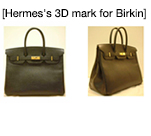 
Hermes filed a suit against DHS to the Tokyo District Court claiming damages caused by infringement of Birkin's 3D trademark and unfair competitions, and sought an injunction against DHS's sales of handbags.
Allegations
Hermes asserted 1) that their handbags called Birkin were extremely well known and thus worked as their business indication, 2) that appearance of DHS's handbags and those of Birkin were similar and 3) that DHS's sales of handbags might mislead consumers.
DHS, in the reply apparently written by themselves without help of lawyers, argued that upon receiving a complaint from Hermes, they had stopped sales of handbags. They also insisted that their bags and Birkin were completely different, since their materials and prices were far different, and thus their bags were not copies of Birkin.
TDC's Decision
1) In determining similarity between a 3D mark and a flat mark, if a view from any specific distinctive side of a 3D shape is similar to that of a flat mark, the 3D mark is similar to the flat mark. Birkin's distinctive side was the front and this was similar to DHS bags' front and thus, they were similar to each other. Although their materials and prices were different, there was no reason to deny likelihood of confusion. Therefore, sales of handbags by DHS constituted an infringement of Hermes's 3D trademark.
2) DHS's sales of handbags were the use of Hermes's well-known business indication. Therefore, DHS's acts constituted unfair competition.
3) DHS's handbags were poor quality products and thus sales of such products damaged Hermes's reputation.
Finally, the TDC ordered an injunction of sales of handbags and a payment of compensation for damages in an amount of JPY 2,350,000.- (approx. USD23,500.-), including Hermes's lost profit (interest gained by DHS) and a compensation for damage to reputation.
An appeal to the IPHC was not filed against this decision, and thus the decision is final and binding.
|
|
K&P's Comments
This is a rare case where similarity and infringement of a 3D mark were issues. Generally, it is believed that a trademark right for a 3D shape is valid against only its dead copies. But, this was not the case.
In the decision, the TDC stated that similarity should be determined on the basis of whether there is likelihood of confusion, and to determine whether there is likelihood of confusion or not, actual business in the market should be considered. The TDC also stated that if a view from a distinctive side of a 3D shape was similar to a flat mark, they were similar in appearance. Finally, the TDC concluded that DHS's handbags were similar to Birkin since their front sides were similar, but no consideration seemed to be paid to actual business.
It is true that DHS's handbags very easily recalled Hermes's Birkin, especially to ladies loving high end fashion. However, was there really any confusion between Birkin and its parody trompe l'oeil handbag made of nylon? Was Hermes's reputation really damaged by its parody products? Was it reasonable to exclude parody products, based on a 3D trademark right? Although DHS's argument was not sufficient, we believe this decision went too far.
|
|
In May 2014, the IPHC handed down 3 decisions on trademarks, all of which maintained the previous JPO�s decisions.
|
|
| |
|
|
| |
|
|
|
|
|
 |